How Trump's 108-Minute State of the Union Killed the Presidential Sound Bite Forever
The longest congressional address in history signals the end of concise political messaging and the rise of attention-as-dominance strategy.
At 108 minutes, Donald Trump's State of the Union address on Tuesday night didn't just break Bill Clinton's 24-year record by eight minutes. It marked the moment American political communication officially abandoned the discipline of brevity for the raw power of sustained attention capture.

Since The American Presidency Project began tracking speech lengths in 1964, no president has consistently pushed the boundaries like Trump. His first-term State of the Union addresses averaged 1 hour and 20 minutes, already the longest of any president on record. Tuesday's marathon wasn't an anomaly. It was the logical endpoint of a communication strategy that views extended airtime as political dominance.
The Mathematics of Political Attention
The numbers tell a stark story about how presidential communication has evolved. George W. Bush kept his 2005 State of the Union to 53 minutes and 20 seconds. Barack Obama's 2009 address ran 51 minutes and 44 seconds. These presidents understood the traditional wisdom: respect your audience's time, make your points efficiently, leave them wanting more.
Trump obliterated that playbook.
His 2018 debut State of the Union ran 1 hour, 20 minutes, and 32 seconds. His 2019 address stretched to 1 hour, 22 minutes, and 25 seconds, making it the third-longest in recorded history. His 2020 speech clocked in at a similar marathon length. Each successive address tested the boundaries of what audiences would tolerate.
Tuesday's 108-minute address represents the culmination of this strategy. According to analysts who tracked the speech, Trump maintained focus throughout, delivering what many described as his most tightly scripted and well-delivered address to date. The length wasn't accidental bloat. It was strategic occupation of the national conversation.
When Endurance Becomes the Message
Traditional political wisdom suggests that attention spans are shrinking, that modern audiences demand bite-sized content. Trump's approach suggests the opposite: in an era of infinite content options, commanding extended attention becomes a demonstration of political strength.
Despite its near two-hour length, this State of the Union was one of President Donald Trump's most focused, most tightly scripted and well delivered speeches.
The strategy works because it forces a binary choice. Either audiences tune out entirely, or they commit to the full experience. Those who stay become deeply invested participants rather than casual observers. The length itself becomes part of the political theater.

Compare this to Clinton's record-setting 2000 address. At 1 hour, 28 minutes, and 49 seconds, Clinton used the extended time to methodically tout his economic achievements and outline his vision for the nation's future. The length served a substantive purpose: comprehensive policy explanation.
Trump's approach is different. The length serves as content itself, a demonstration that he can command the room, the airwaves, and the national conversation for as long as he chooses.
The Death of Presidential Restraint
Presidential communication has historically operated under unwritten rules of restraint. You don't monopolize too much time. You respect the gravity of the office by being economical with words. You demonstrate leadership through discipline.
These norms emerged from an era when presidential access was limited and precious. When presidents appeared on television infrequently, every word carried weight. Brevity signaled respect for the audience's time and the office's dignity.
Trump's marathon addresses signal that this era is over. In a media landscape where presidents can communicate constantly through social media, traditional restraints feel antiquated. Why limit yourself to an hour when you have a captive audience of lawmakers and millions of viewers?
The approach mirrors broader changes in media consumption. Podcast listeners regularly engage with three-hour conversations. Streaming audiences binge entire seasons. Extended content isn't just tolerated; it's often preferred by engaged audiences.
Tactical Advantages of the Marathon Format
The extended format offers several strategic advantages that shorter speeches cannot provide. First, it allows for comprehensive narrative construction. Instead of hitting policy highlights, Trump can build complete arguments, address counterpoints, and reinforce key themes through repetition.
Second, the length creates natural news cycles within the speech itself. Early segments generate immediate social media reaction, middle portions sustain engagement, and concluding remarks provide lasting impressions. Traditional hour-long addresses create single news cycles. Marathon addresses generate multiple waves of coverage.
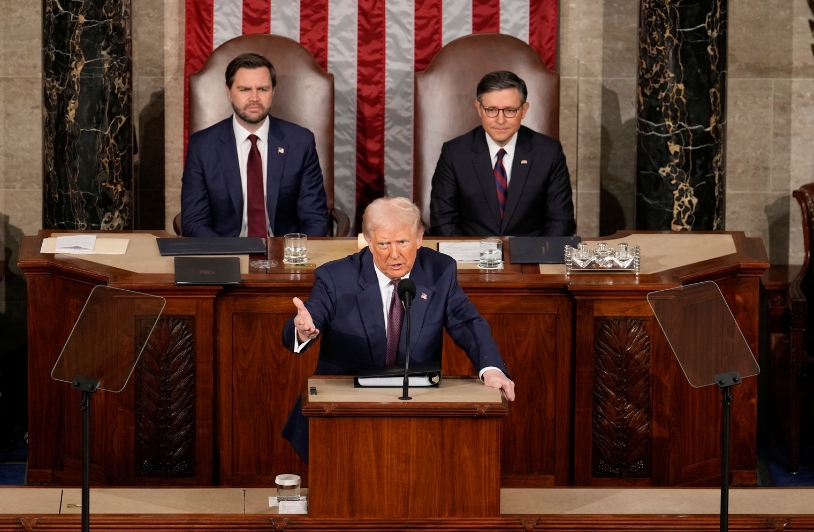
Third, extended speaking demonstrates physical and mental stamina. Political observers noted Trump's energy and focus throughout the 108-minute address. The performance becomes part of the message: a president capable of sustained, coherent communication for nearly two hours.
Finally, the marathon format forces media coverage decisions. News organizations must choose between comprehensive coverage and selective highlights. Either choice benefits Trump: comprehensive coverage amplifies his message, while selective coverage allows him to claim media bias in omitting important segments.
What This Means for Future Presidents
Trump's success with extended addresses creates a new template for presidential communication. Future presidents will face pressure to match or exceed these timeframes, or risk appearing less committed to their message.
The implications extend beyond State of the Union addresses. Campaign speeches, press conferences, and policy announcements will all be measured against this new standard of extended engagement. The presidential sound bite, once the currency of political communication, may become as obsolete as handwritten letters.
The length itself becomes part of the political theater, forcing audiences to choose between complete disengagement or deep investment in the presidential message.
This shift reflects broader changes in how authority figures communicate across industries. Business leaders host extended podcasts, educators create comprehensive online courses, and entertainers produce marathon content. The presidency, always a reflection of broader cultural trends, is adapting accordingly.
The real question isn't whether future presidents will adopt similar approaches, but whether American political institutions can adapt to this new reality. Congressional schedules, media coverage patterns, and public attention cycles all evolved around predictable, contained presidential communications.
The New Rules of Political Engagement
Trump's 108-minute address establishes new expectations for presidential communication that will outlast his administration. The traditional constraints of time, attention, and institutional norms have been permanently altered.
For voters, this means presidential messages will increasingly require significant time investments to fully understand. Surface-level engagement with presidential communication becomes insufficient when the format demands extended attention.
For media organizations, it means developing new frameworks for covering marathon political communications. Traditional highlight reels and summary coverage may prove inadequate for addresses designed to be consumed in full.
Most importantly, it signals that the presidency itself has evolved from an institution bound by tradition to one that actively reshapes the boundaries of political communication. The office hasn't just adapted to modern media; it's begun to dictate the terms of engagement.
When the next president takes office, they'll inherit not just the powers of the presidency, but the expectation that commanding national attention means commanding it completely, comprehensively, and for as long as necessary to make your point. The age of presidential brevity is over. The era of endurance politics has begun.