Apple Just Admitted It Can't Build AI
The $1 billion Gemini deal reveals how the company that promised 'it just works' lost the most important race in tech.
Apple will pay Google $1 billion annually to power Siri with Gemini AI, marking the first time in the iPhone era that Apple has handed control of a core user experience to a direct competitor. This isn't just another partnership deal. It's an admission that the company built on vertical integration and "thinking different" can no longer keep up with the fundamental technology reshaping computing.

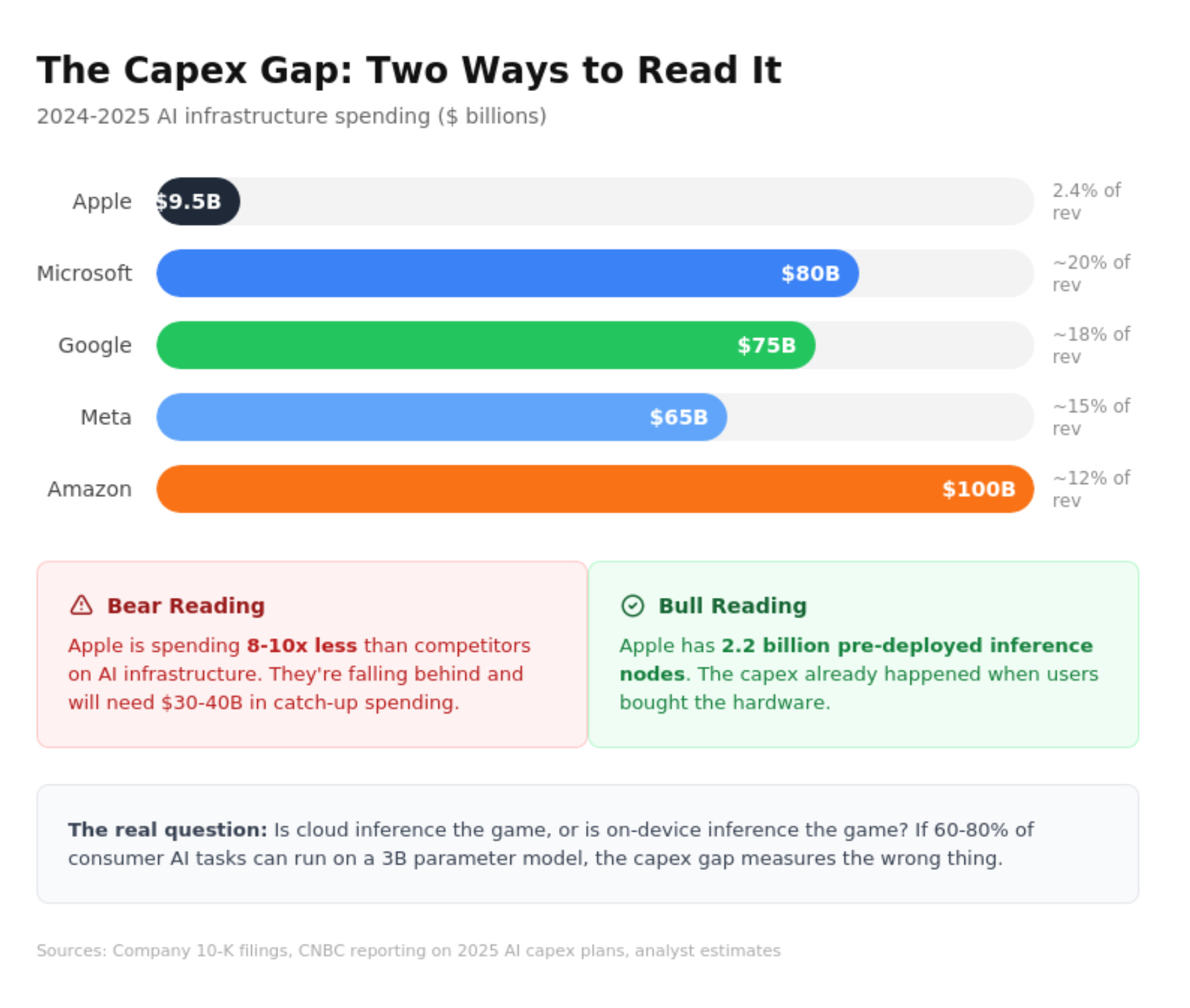
The February 2026 rollout of Gemini-powered Siri represents more than a product update. It signals that Apple's $12.7 billion AI investment in fiscal 2025 wasn't enough to compete with Google's massive infrastructure spending. While Microsoft, Google, and Meta each pour $50-100 billion annually into AI development, Apple chose a different path: admit defeat and rent someone else's intelligence.
The Numbers Don't Lie About Apple's AI Gap
Apple's AI spending looks microscopic next to its competitors. The company's $12.72 billion AI capital expenditure in 2025 pales against Google's massive cloud infrastructure investments. Independent benchmarking shows Apple's models consistently score lower on reasoning, mathematical problem-solving, and complex language understanding tasks compared to OpenAI, Google, and Anthropic systems.
This performance gap isn't temporary. It reflects a structural disadvantage that money alone can't solve quickly.
Apple's traditional approach of perfecting technology in secret, then launching a superior product, doesn't work in AI. The field advances too rapidly for Apple's methodical development cycle. While Apple spent years building Apple Intelligence features that feel limited compared to ChatGPT or Claude, Google and OpenAI kept pushing boundaries with models that can handle increasingly complex tasks.
The $1 billion price tag tells the real story. Apple isn't buying a small software component. It's paying for access to capabilities it cannot replicate internally, despite having more cash than most countries' GDP.
Why This Partnership Breaks Apple's Sacred Rules
Apple built its empire on controlling every aspect of the user experience. The company designs its own chips, writes its own software, and manufactures products to exact specifications. This vertical integration created the seamless experience that justified premium pricing and generated fierce customer loyalty.

The Gemini deal shatters this philosophy. Apple is handing Google control over Siri's "summarizer and planner functions" - the core intelligence that determines how users interact with their devices. Every time someone asks Siri to plan a trip, summarize emails, or handle complex requests, Google's AI will process that interaction.
This creates unprecedented dependency. Apple's most personal product feature now relies on a competitor's technology stack. If Google decides to change terms, prioritize its own products, or simply improve Pixel integration faster than iPhone features, Apple loses control over a fundamental user experience.
Apple is executing what analysts call a "Device-Layer Control Inversion" - recognizing that controlling the device matters more than controlling the AI, but this strategy assumes Google won't build better devices.
The partnership also raises privacy questions that Apple hasn't fully addressed. The company built its brand on protecting user data, but now user interactions flow through Google's systems. Apple claims data stays secure, but the fundamental architecture creates new vulnerabilities and dependencies.
The Timing Reveals Apple's Desperation
Apple's AI timeline shows how far behind the company has fallen. While Google demonstrated multistep task automation with Gemini on Pixel and Samsung Galaxy S26 phones, Apple is still promising basic Siri improvements for February 2026. Google already beats Apple to market with agentic AI features that can order food, hail cars, and coordinate complex workflows.
The February reveal represents Apple's first major Siri overhaul in years, powered entirely by Google's technology. This isn't Apple iterating on existing capabilities. It's Apple admitting its internal AI development couldn't produce competitive results.
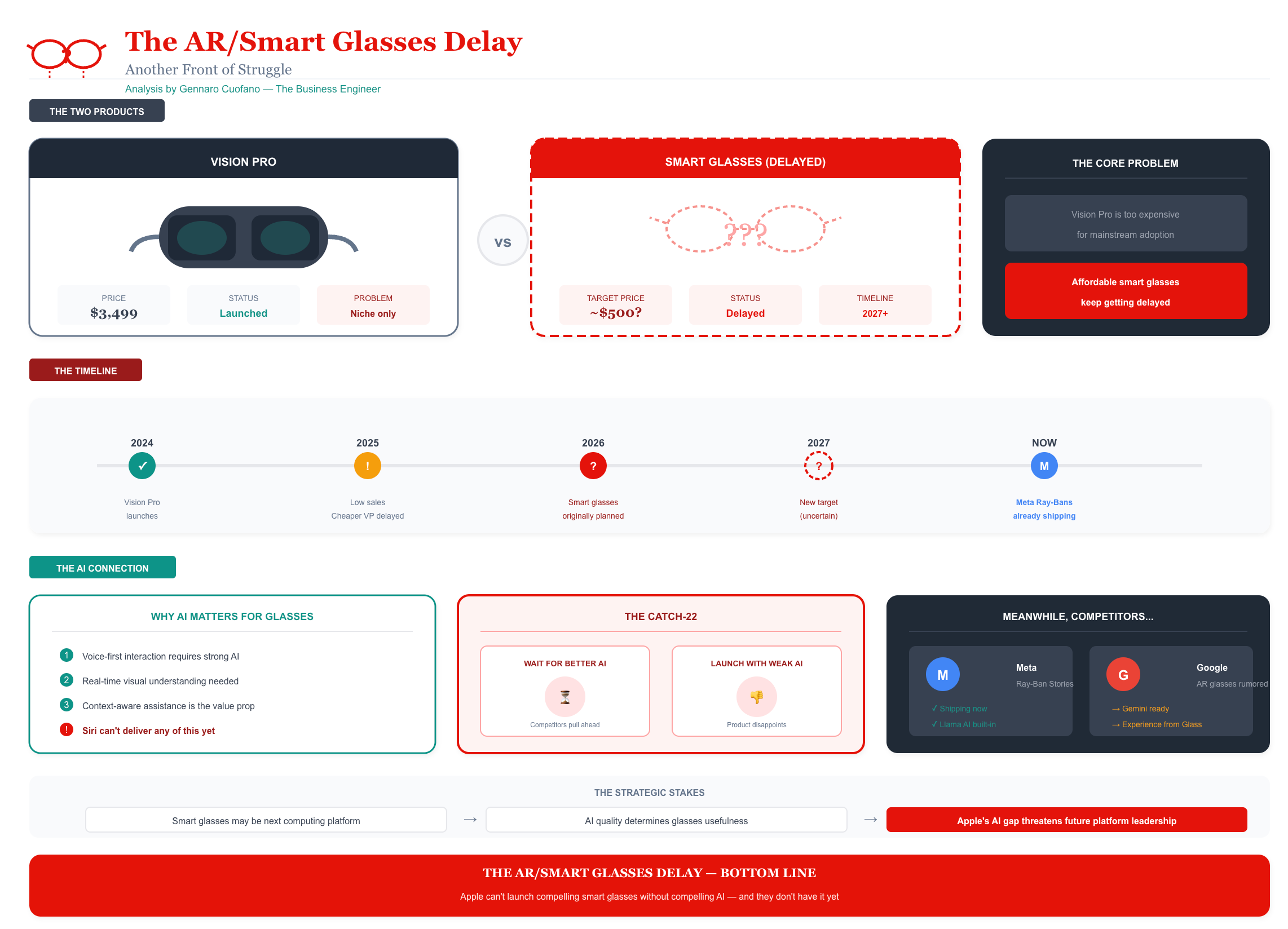
Enterprise customers already notice the gap. Apple Intelligence features work well for basic tasks but feel limited compared to ChatGPT, Claude, or even Google Assistant for complex problem-solving. Business users increasingly choose Android devices or supplement iPhones with other AI tools because Siri can't handle sophisticated requests.
This enterprise weakness matters more than consumer market share. Enterprise adoption drives long-term platform loyalty and developer investment. If businesses conclude that iOS can't support advanced AI workflows, Apple loses influence over the next generation of computing platforms.
What Apple's $600 Billion Manufacturing Plan Really Means
Apple announced a $600 billion domestic manufacturing commitment alongside the Gemini partnership, signaling a fundamental strategy shift. The company is moving from software-focused AI development to hardware infrastructure investment, betting that controlling the physical layer matters more than controlling the intelligence layer.
This represents a massive strategic pivot. Instead of competing directly with OpenAI and Google on model capabilities, Apple is building the infrastructure to manufacture AI chips and servers at scale. The plan mirrors energy sector deployments more than traditional tech development, suggesting Apple sees AI as a utility requiring massive physical infrastructure rather than just clever software.
The manufacturing investment also reveals Apple's long-term calculation. The company believes AI will become commoditized - available from multiple suppliers at competitive prices. By controlling hardware production and device integration, Apple can maintain margins and user experience control even while outsourcing the core intelligence.
Apple's bet is that AI becomes a commodity input like memory or storage, where controlling integration matters more than controlling the underlying technology. History suggests this rarely works when the underlying technology remains rapidly improving.
The Wall Street Blind Spot
Financial markets haven't fully grasped what Apple's AI dependence means for the company's competitive position. Apple's stock continues trading on iPhone sales growth and services revenue expansion, but these metrics miss the structural shift happening in computing platforms.
The Gemini deal creates new risks that traditional Apple analysis doesn't capture. Google now has unprecedented insight into iOS user behavior and preferences. This data advantage could inform Google's own hardware development, search algorithms, and advertising targeting in ways that gradually erode Apple's ecosystem advantages.
Apple's device-first strategy also assumes that premium hardware will continue commanding premium prices in an AI-dominated world. But if Google's AI capabilities become significantly superior to Apple's, and if that intelligence becomes the primary factor in device selection, Apple's hardware advantages become less relevant.
The $1 billion annual payment to Google represents just the beginning. As AI capabilities expand and become more central to device functionality, Apple's dependence - and payments - will likely grow. This creates a structural drag on Apple's margins that investors haven't factored into long-term valuations.
The Path Forward Looks Treacherous
Apple faces a difficult choice: continue paying Google billions for competitive AI while building internal capabilities, or accept permanent dependence on competitors for core functionality. Neither option preserves Apple's traditional advantages.
The company's manufacturing investment suggests a third path - becoming the premium hardware platform for multiple AI providers while maintaining control over user experience and data privacy. This could work if AI truly becomes commoditized and if Apple can maintain its integration advantages.
But this strategy requires perfect execution at a time when Apple is already behind. The February Siri launch will show whether Apple can successfully integrate Google's AI while maintaining the seamless experience users expect. Early stumbles could accelerate user defection to platforms with native AI integration.
The Gemini partnership marks the end of Apple's AI independence and the beginning of a more uncertain competitive future. For a company that built its success on controlling every detail of the user experience, depending on Google's intelligence represents the biggest strategic gamble since the iPhone launch. The difference is that this time, Apple isn't betting on its own innovation. It's betting on someone else's.